REMT Immersive Experience
Forging Competence Through Intensive, Hands-On Application for Austere Environments
Standard Emergency Medical Technician (EMT) training is designed for urban and suburban environments with rapid transport times and abundant resources. This model creates a critical void when applied to remote, austere, or resource-limited settings where definitive care is hours or days away. The Immersive Remote Emergency Medical Technician (REMT) course is a comprehensive, 20-day program engineered to fill this gap. By integrating the national EMT curriculum with specific skills for prolonged field care in a fully in-person, scenario-based format, the REMT program produces medical providers who possess not only the knowledge but the validated, hands-on competence and critical thinking skills to manage complex medical emergencies independently.
The Remote Medicine Gap
The foundational principle of conventional pre-hospital care is "scoop and run"—stabilize the patient and transport them to a hospital immediately. This paradigm is untenable in remote settings such as wilderness guiding, international disaster response, maritime operations, or industrial sites far from infrastructure.
In these environments, the medical provider faces a different reality:
Extended Patient Contact: Care may be required for 24-72 hours or longer.
Limited Resources: Providers must work with only the equipment they can carry.
Environmental Stressors: Extreme weather, difficult terrain, and low-light conditions complicate every aspect of care.
Autonomous Decision-Making: The remote provider is often the highest, and only, medical authority.
The Ideal Immersive REMT Candidate
This format is designed for individuals who are preparing for an imminent career transition into remote medicine or who can dedicate a focused block of time to training.
It is ideal for:
Aspiring wilderness guides, expedition leaders, and outdoor educators.
Professionals in disaster response, humanitarian aid, and remote industrial safety.
Individuals seeking the most thorough and concentrated hands-on training experience available.
Course Curriculum
The REMT curriculum meets and exceeds the national WEMT standards by systematically building from foundational knowledge to the skills required for prolonged field care.
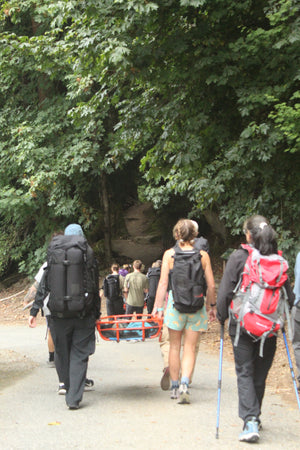
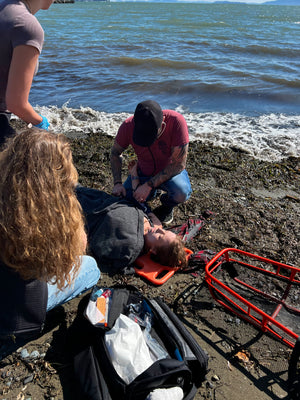
Foundational Care: Students first master patient assessment, stabilization, patient movement in hazardous terrain, and the management of traumatic, medical, and environmental emergencies.
Skills for Prolonged Field Care: The curriculum then introduces the crucial skills needed to manage a patient over time. This is not "advanced" training in the traditional sense; it is the appropriate level of training for the remote context.
This includes:
Airway Management: Placement and management of Supraglottic airway devices.
Intravenous (IV) Access: Establishing and maintaining IV lines for fluids and medication.
Wound Closure Techniques: Hands-on practice with suturing and stapling.
Foley Catheterization & Nasogastric (NG) Tubes: Essential skills for long-term patient monitoring and care.
Medication Administration: Protocols for using a field-appropriate formulary.
Clinical Application: A mandatory 10-hour clinical rotation in a hospital or ambulance setting provides real-world context, bridging the gap between simulation and practice.
Course Details
Pre Requisites:
- 18+ Years old
- High School Diploma or equivalent
- Required proof of Immunizations by first day of course (MMR, Hepatitis B, Varicella, Tetanus, PPD)
- Ability to lift 250 lbs with assistanceCopy of Government Issued photo ID
Duration: 4 weeks of in-person training - 8 hours per day.
Clinical Rotations: Students will be required to complete a minimum of 8-12 hours of clinical rotations while on course. These will be scheduled over the weekends
Text Books:
Required to purchase: Emergency Care, 14 Edition, Limmer
Included: Remote Medical Training REMT Student Manual
Grades: RMT utilizes a pass/fail grading system based upon the below criteria. Students who pass the course, or the remediation process will receive a “passing” grade. Passing means that the student will be verified on the NREMT website as having successfully completed the course allowing them to take the NREMT cognitive exam and test for their NREMT certification. Students who receive 3 or more strikes or who do not pass remediation will be issued a “failing” grade and will not be verified to take the NREMT cognitive exam.
Attendance: Students may miss up to 10% of the total course hours with an excused absence and should be clearly communicated with the Lead instructor prior to missing class.