
Steph brings over a decade of experience in expeditionary leadership, experiential education, and risk management in remote mountain and river environments to her role as an instructor. Currently a professional ski patroller at Stevens Pass and a former instructor with the Northwest Outward Bound School, she specializes in high-acuity trauma care, prolonged field care, and avalanche rescue. Holding a Washington State EMT-B, a Wilderness First Responder certification, a Responder Alliance Psychological First Aid endorsement, and a Blaster’s License, Steph is uniquely equipped to bridge the gap between theory and practice. By drawing on her extensive background in high-stakes, austere environments, she expertly brings the true realities of extended remote field care directly into the classroom.
The Journey to Remote Medicine
As my passion for spending extended time in the backcountry met professional licensure in EMS, stepping into an educator role within backcountry medicine seemed like a natural progression. My history with experiential education in backcountry settings, along with my practical experience as a care provider for trauma and medical patients, positioned me well to begin my journey as wilderness medicine educator.
Specialized Industries
Ski Patrol
Avalanche Rescue & Backcountry Skiing
Experiential Education, Summer Camps, and Primary and Secondary School Education
Mountain Expedition Leadership and Extended Field Care

I am big on backcountry skiing, multi-day river trips with big rafts and bigger smiles, and gravel biking. I carry hot sauce everywhere I go and I love my dog!
Teaching Philosopy
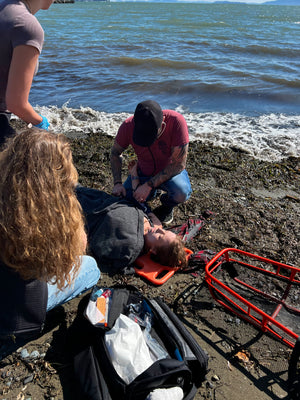
I prioritize balancing field-based experiential learning and focused instruction. My approach is grounded in the belief that once students develop a working understanding of thorough patient assessment and essential field-applicable treatments, the most effective use of time is applying that knowledge in practice. I keep demonstrations and lectures concise and goal-oriented, creating space for scenario-based learning where students actively engage with realistic situations. Through this process, students build both the muscle memory required for efficient patient assessment and the critical thinking skills needed to navigate the complex, unpredictable challenges inherent to backcountry environments.
Why I Choose to Teach
I want everyone to spend more time in the backcountry, and enjoy creating space for people to develop better risk-management skills, refine their medical assessment frameworks, and practice their field treatment skills within a safe learning environment—all with the goal of increased accessibility and safety within the field.
Professional Certifications & Licensures
EMT
Ski Patrol
Most Memorable Field Experience
While teaching in the remote Boundary Waters of Minnesota, students pointed out that they lacked access to equipment like vacuum mattresses and rigid spine boards while in the field. This sparked a practical question: how do we effectively protect the cervical spine without these tools? Rather than providing an answer, I encouraged the group to work through the problem themselves. They spent the afternoon designing and building an improvised litter and c-spine stabilization system using a canoe, blankets, sleeping pads, and webbing—materials they routinely carry.
This experience stands out because it reflects a core teaching philosophy of mine: in wilderness medicine, perfect tools are rarely guaranteed, but clear objectives and adaptable thinking are. By focusing on the underlying goal—in this case, maintaining c-spine precautions—students learn to apply their knowledge creatively and confidently in real-world conditions. It’s quite delightful to watch students use critical thinking skills to solve backcountry challenges and gain confidence in their ability to problem-solve unfamiliar hurdles.